Use cases
One method, applied where documents slow the work.
We start with your documents and the work your team needs to do. Answers show their sources, extracted records link back to supporting evidence, and tests reflect the consequences of getting something wrong.
- 01
Operator and maintenance questions
Typical documents. Operating manuals, maintenance procedures, fault guides, work instructions.
- Who it is for
- Operators and technicians on the floor.
- The problem
- The answer is in a manual or fault guide, and finding it takes longer than the fix.
What you get
- Plain-language questions answered from your procedures, manuals and fault guides.
- Every answer shows the document and page behind it.
- When the documents do not cover the question, the assistant says so and, in a full build, passes it to a named expert.
How we test it. We test it on your operators' real questions, including ones the documents do not cover. Your team approves the results before handover.
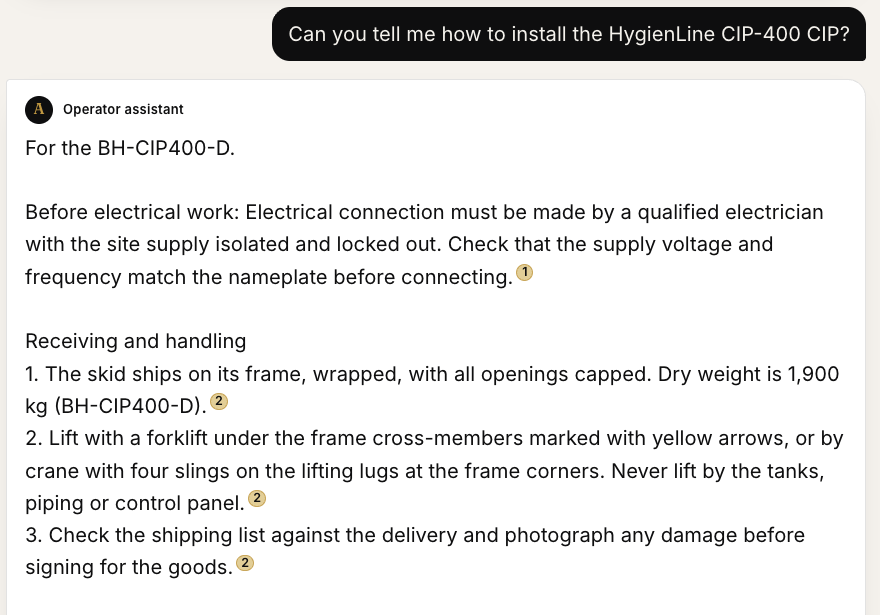
Installation steps start with electrical safety, and each step cites the manual. 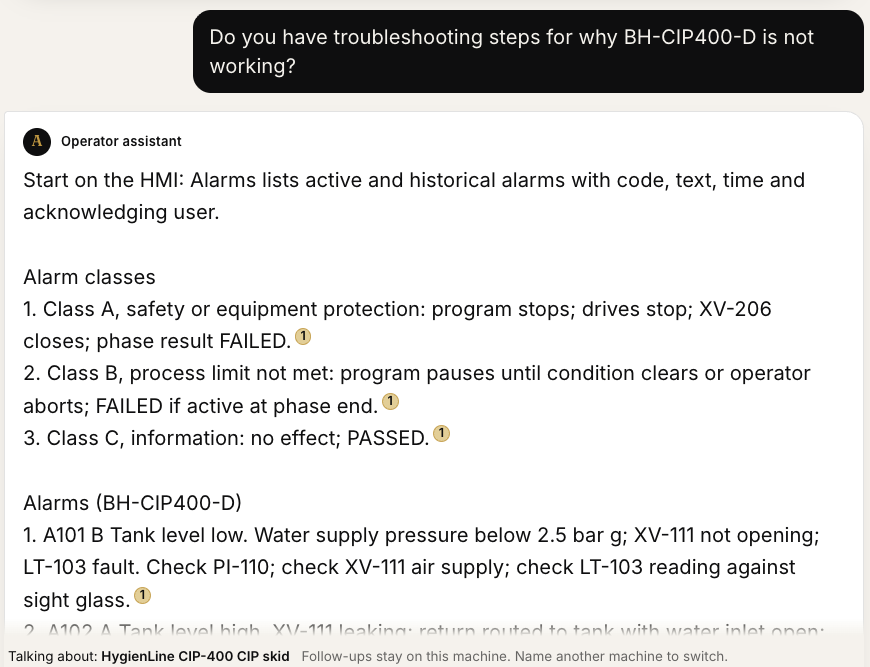
Troubleshooting starts on the HMI alarm list, with a check and a citation for each alarm. From our operator-assistant demo, built on an original demo manual. For demo purposes only.
- 02
Tender and RFQ review
Typical documents. Tender packages, RFQs, technical specifications, client standards.
- Who it is for
- Bid and proposal engineers.
- The problem
- Requirements, equipment, standards and deviations sit across hundreds of pages.
What you get
- The package read page by page, with requirements, equipment, standards and possible deviations gathered into one list.
- Each item linked to the page it came from.
- Your engineers check the list and decide; the bid stays theirs.
How we test it. Before use, we compare the extracted register with an engineer-reviewed reference, checking completeness, field accuracy and source links. Your engineers approve the result before it informs a bid.
- 03
Quotes and engineering
Typical documents. Past quotes, product specifications, datasheets, internal standards.
- Who it is for
- Sales and application engineers on configure-to-order and engineer-to-order requests.
- The problem
- The closest past quote exists somewhere in old files.
What you get
- The closest past quotes, specifications and standards, found in seconds when a new request arrives.
- A clear view of where the new request differs.
- Prices and technical decisions stay with your people.
How we test it. We run real past requests and check that it finds the quotes your engineers would pick and flags the differences.
- 04
Knowledge handover
Typical documents. Interviews with experienced staff, notes, checklists, lessons learned.
- Who it is for
- Teams preparing for a senior engineer to retire or move on.
- The problem
- Key know-how lives with one person.
What you get
- What your senior engineer knows, captured as short written answers.
- Answers new people can find long after the handover.
How we test it. Your team reviews each written answer before it becomes a source.
- 05
Testing assistants and document extraction
Typical documents. Real user questions, approved answers, representative source documents, engineer-reviewed reference records and the system's current outputs.
- Who it is for
- Teams already running an assistant or document extraction.
- The problem
- You need to know where it is reliable before people depend on it.
What you get
- For a question-answering assistant, answers tested against approved sources, including when it should ask for help.
- For document extraction, records checked for captured and missed requirements, correct quantities and units, and supporting evidence.
- Checks defined with your engineers, using representative documents and reviewed examples. Where automated scoring is useful, we check it against your team's reviewed examples.
- Documented tests you can repeat as documents, prompts or models change, for a system your team already runs or a build we deliver.
How we test it. Acceptance criteria reflect the consequences of an error, with separate checks for critical omissions, unsupported values and items that need human review. Quantities, units and required fields use explicit checks; judgements about meaning remain subject to human review.
Start with a call to choose the right scope. The Assistant Pilot tests one document set, and the Workshop teaches your team to evaluate question-answering assistants. Complex extraction and customer-hosted evaluation are scoped separately.
The results on the Proof page come from product-knowledge and support assistants. See the proof.
What does your plant need to know when your best person is out?
Start with one department and the questions that keep coming up. We'll talk through the documents you have and whether a fixed-price build is a good fit.
Book a 30-minute call